If you are considering getting involved in this important research, the information below will help you to make an informed decision on whether participation is right for you. If, after reading, you have any questions or would like to express an interest in participation, please email a.obradovic340@canterbury.ac.uk, or visit the ‘Get in touch’ page to send a direct message.
What is the purpose of the study?
The aim of this study is to better understand which aspects of healthcare and support services are experienced as more and less challenging for trans survivors of sexual violence and how these impact on feelings and attitudes towards self and help-seeking. We hope that by speaking to individuals who have sought help/considered seeking help from mainstream (NHS, police) and specialist services (crisis centres, support networks, etc), we will be able to better understand trans experiences and improve support services for trans survivors in the future.
The research seeks to contribute towards one of the first guidelines for informing a culturally competent and inclusive model of survivor healthcare and support.
Why have I been invited?
You have been invited to take part because:
- you identify as trans, genderqueer, genderfluid, agender, gender non-conforming or non-binary
- you identify as having experienced some form of sexual violence (not within six months of the interview date)
- we are interested to confidentially and respectfully hear about your experience of seeking (or not seeking) help following this/these event(s).
Do I have to take part?
No, you are under no obligation to take part in the study and should not feel coerced (forced) into doing so. If you do decide to take part, you are free to withdraw from the study up to the point at which the data is analysed. Should you choose to withdraw, you may do so without disadvantage to yourself and without any obligation to give a reason.
Please feel free to ask any questions if you are unsure or if you would like to discuss the study further (see contact details listed at the end of this information sheet). If you are happy to continue with the study, you will be asked to sign a consent form to say that you have understood what participation entails and agree to be involved. Please keep this website address so that you can refer back to the information if you need to.
What will happen if I take part?
You will take part in a one-to-one informal interview and will be asked to describe your personal experience of and perceptions of help-seeking following sexual violence. This can take place in a private space at SurvivorsUK, or at an alternative location of your choosing. In some cases, if preferred, it may be possible for the interview to take place over Skype. The session will not be interrupted, but I may be required to check in and out of our meeting by telephone, depending on where the interview takes place.
At the beginning of our meeting, you will be given the opportunity to read through this information again and ask any questions that you may have before the interview begins. The interview will be approximately 75 minutes in duration and will be recorded with an audio recording device so that I can transcribe (write up) the interview at a later stage.
With your agreement, you may be contacted at a later date by telephone or email to clarify some of the things you said in your interview. This is so that I can be sure that I have understood your words in the way you wished for them to be understood.
Will my taking part in the study be kept confidential?
Yes – only the interviewer (me) and anyone that you choose to tell will be aware that you are taking part in the study. Any information (data) that you give in your interview will remain strictly confidential. The only exception to this is if I am concerned about your safety, in which case your G.P. may be contacted. This will be discussed openly with you at the time, should such a situation arise.
The audio recording of the interview will be kept in a secure, electronic location until the study has been completed, after which the recording will be destroyed. When the interview is transcribed, your name (as well as any identifying references) will be removed from the transcript to protect your confidentiality and anonymity. The anonymised transcripts may be retained for further analysis / reference for up to 10 years after the study has been completed, but data will not be traceable to its source.
What are the possible benefits of taking part?
By taking part in the study, you will be contributing to research that aims to improve services for future trans survivors of sexual violence, as well as trans service-users more generally. You will have the chance to speak in as much detail as you would like about your experience of help-seeking following the traumatic event and the impact this has had on your use and opinion of services. Many people find it cathartic (emotionally relieving) to have the opportunity to discuss their experience.
You may request reimbursement for your travel expenses (where applicable), and in exchange for your time, I will make a donation in your name (or anonymously) to an organisation offering support to trans survivors of sexual violence.
What are the possible disadvantages/risks of taking part?
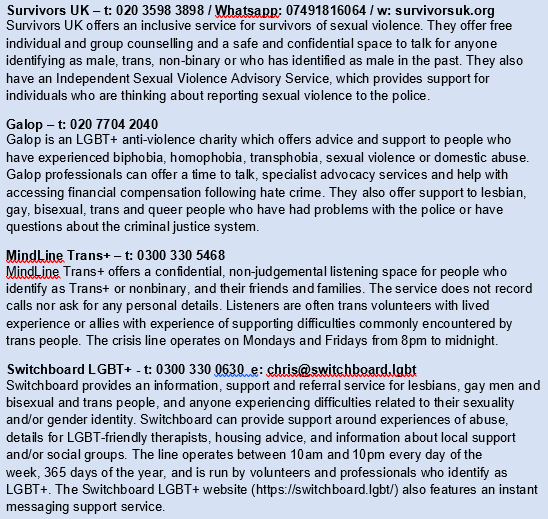
It is not expected that you, the participant, should experience any disadvantage either during or after the interview, although it is recognised that thinking back to adverse life experiences may be difficult and upsetting. You are welcome to take a break from the interview, or terminate it at any time you wish. Should you encounter any distress in the days following the interview, please contact your G.P. or one of the organisations listed below.
What will you do with the findings from the study?
Once all data gathered in the study has been analysed and written up, the research will be offered for publication in an academic journal. The research team will also create a set of guidelines based on the study findings, which will be disseminated to relevant support services to help inform their practice. Please note that although direct quotations from the interviews will be used, your identity will remain anonymous at all times. Your data will never be shared and your personal details will not be identifiable at any point during or following the research.
What if there is a problem?
If you have any questions or concerns about how the study has been conducted, please contact the Chair of the School of Psychology Research Ethics Sub-committee on 01227 927700.
 Help-seeking among trans survivors of sexual violence: Towards a more inclusive framework of support.